
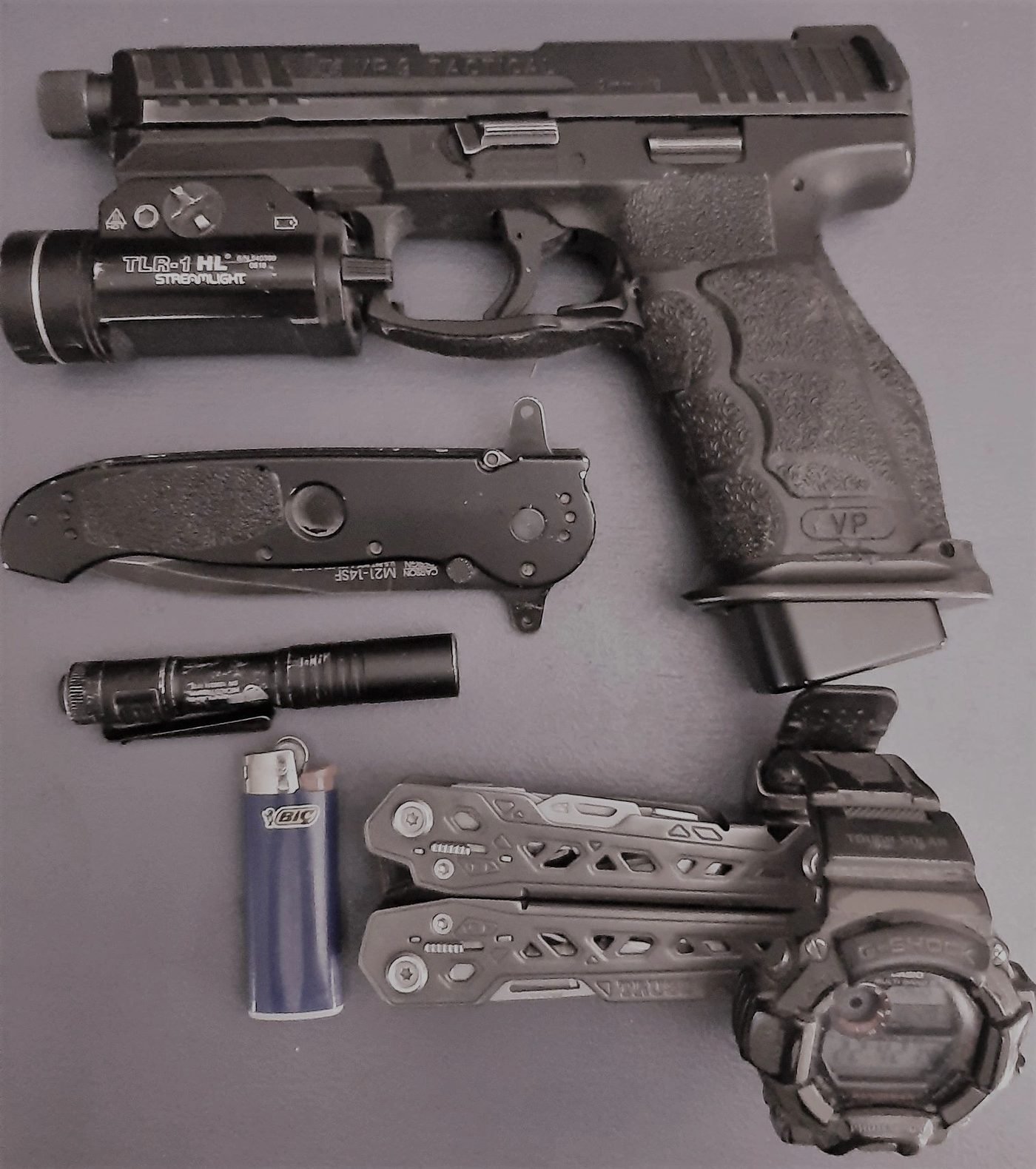
Everyday Carry or EDC is a concept that has gained traction and recognition in the last several years. It refers to the items you carry on your person each day. You can search the internet and find countless articles on the subject. I have read EDC recommendations from a multitude of people with varying backgrounds. The number of EDC items that some recommend would require a backpack or, at a minimum, cargo pants of some type. You shouldn't dismiss these recommendations just because of the larger quantity of items. If you are new to personal protection, you will find a lot of great ideas to help build out your EDC.
For routine daily activities I would recommend a pocket knife, small led flashlight, and a firearm, at a minimum. I realize that most carry a cell phone that can be used as a flashlight. I also have one. However, the beam distance of a flashlight on your cell is usually not that far. Cell phones will have a larger "spill" area of light, which is the distance to side of the beam that is illuminated.
I adjust the items I carry based on the activity I am undertaking. If I am going to an event that requires a suit, I opt for a subcompact firearm, as a suit is not the greatest at hiding a full sized handgun. If I planned to go hiking in the mountains, then I would carry a small backpack with snacks, water, water purification, first aid supplies, a compass, a signaling device, fire starters, a fixed blade knife, a map of the area I'm in, and some other basic necessities. This would be about 4 to 6 pounds of gear. What I consider basic necessities, may be different from what you consider basic necessities, based on your skills and experience. I carry gear to assist in my survival, in case I find myself injured and unable to make it back to camp, or for some other reason unable able to get back to my starting point. If you're considering outdoor wilderness trips it would be beneficial for you to learn some basic outdoor survival skills. For example, what's the point of a map and compass if you don't know how to read a map or use a compass in conjunction with a map. I know what some are thinking right now. You're thinking you'll just get a GPS or use your phone's GPS. GPS devices are great tools but don't bet your life on an electronic item for navigation. Carry a backup like a map and compass. Talk to search and rescue personnel, military or law enforcement and ask if they would bet their life on an electronic system like a GPS. Most will say no. I have learned over the years that technology is great when it works. Technology seems to work great when your using it normally, but the one time you really need it, it decides to ruin your day. Outdoor survival skills is a topic for another time. Back to EDC, make sure what you're carrying makes sense for your day and consider a backup for the most critical items.
You should also consider your profession when determining the appropriate EDC items. I know EMTs that carry small trauma packs on their person and load their vehicles with medical kits. Several times when arriving on the scene of a crash with injuries I have been met by off duty medical personnel that happened by and stopped to render aid. Thank you for those who do that. I am not an EMT, or paramedic and I do not posses anywhere close to the skills they have. I am a basic first responder. So, having the expertise and tools of those skilled professionals, when I arrive on a situation with severe injuries, is a huge help and at times is the difference between life and death. I also know business professionals who carry athletic shoes or hiking boots with them to ensure that if they have to unexpectedly walk a long distance they don't have to do so in dress shoes.
Most of us utilize our vehicles during our day to day travels. Your vehicle is an extension of your EDC. It is a spot where you can carry some extra supplies or gear to complement what you carry on your person. Again, the gear you carry in your vehicle may depend on a number of factors, including the season, the number of people you plan to have with you, the age and abilities of the people with you, and the location you are traveling to. For example, you may want to add extra water, snacks, batteries, first aid supplies, clothing, communication equipment, or prescriptions medications. Consider snacks that will last, regardless of heat or cold, like energy bars, dried fruit, and nuts. Items like a med kit for injuries, road side signaling devices to alert traffic that your vehicle may be a hazard, a vehicle fire extinguisher, and a small tool kit are good additions to a car kit. If you don't have a spare tire I would suggest you get one or have additional items to deal with a flat tire like fix-a-flat. A battery operated jump pack and air compressor are nice additions to a vehicle kit as well. During the winter months, if you live in a cold climate, you may need additional cold weather gear for you and your family. If you have young children you might want a change of clothes, extra diapers, or baby formula. The important thing is that you design your EDC based on your and your family's needs. You don't need to fill up the trunk or truck bed with a month's worth of supplies or get a trailer of EDC loaded up every time you run to the store. Basically, you want to have the necessities to get you through a shorter period like a day or two.
Keeping an emergency cell phone charger and spare charging cord in your vehicle is also extremely important. Over the years, I have helped many people who were sitting on the side of the road for hours, before I came across them during my patrols and checked on them. In some cases their cell phone was dead, or they didn't have a cell, and they didn't have a way to contact anyone for help. Some of those people were truly disheartened that so many vehicles passed them and nobody stopped to check on them. If you're able to safely help those around you, be that person. Your defensive skills and other skills you develop for personal protection will give you peace of mind when stopping to help strangers.
My advice for EDC would be to first take a little bit of time to figure out what items you need to provide safety and security for yourself and those you are responsible for. Next, build up you EDC to include the items you determined you need. Finally, educate those family members that may be in your vehicle, to the items you have, in case your spouse or children are the ones using the vehicle when a bad situation arises.
Be a Ready American.